
Activities
Medicinal and aromatic plants
Twenty-two species under organic certification, and the drying that decides their quality.
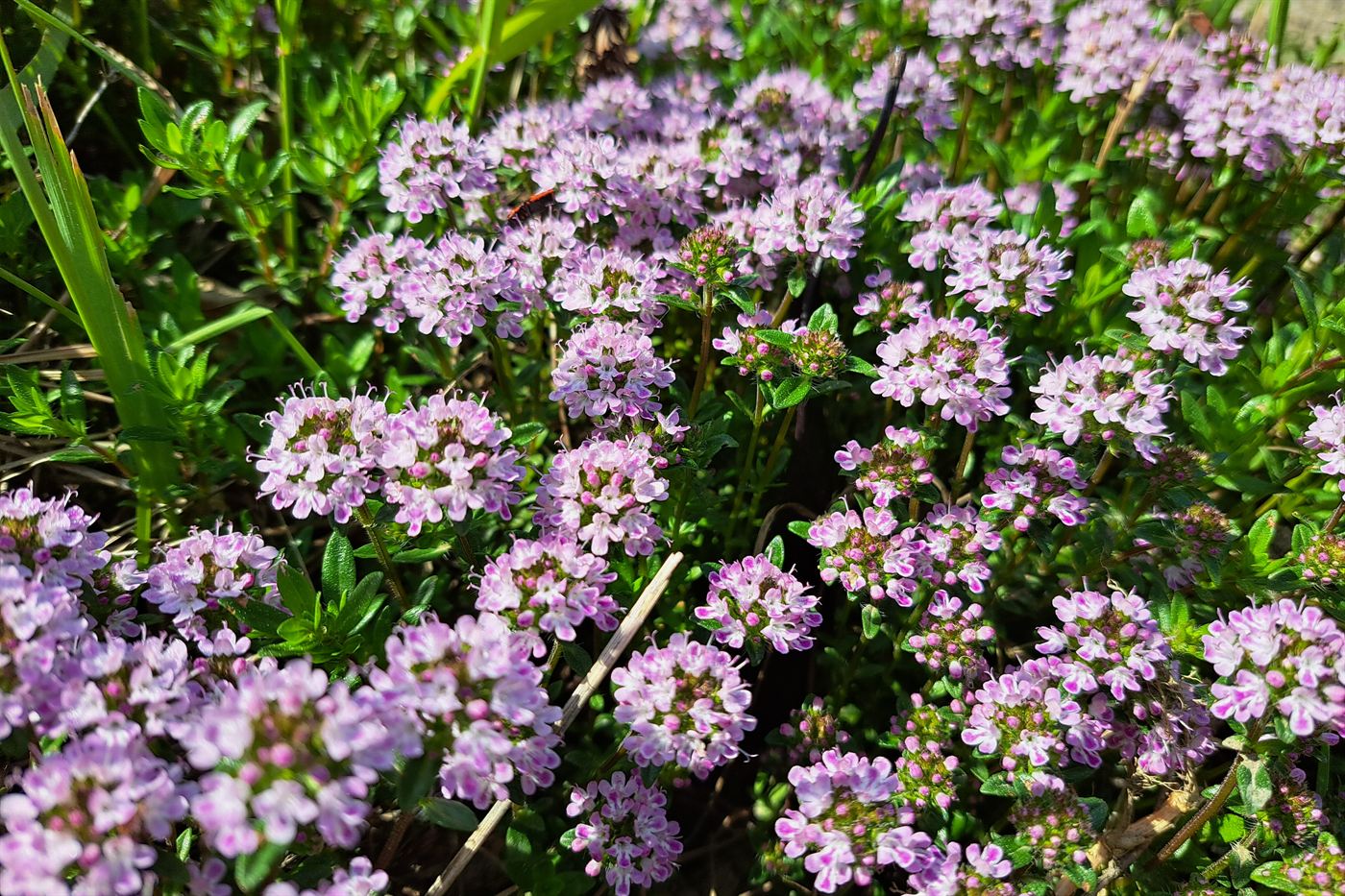
Monasteries grew physic gardens for a thousand years, and it would be easy to make too much of the coincidence. The reason this farm grows medicinal and aromatic plants is not historical: it is that they are among the very few crops where twelve hectares can compete with two hundred. Value per hectare is high, the work is skilled rather than mechanised, and quality is decided by judgement at harvest and in the drying room — which is precisely where a small operator has the advantage.
« Infirmorum cura ante omnia et super omnia adhibenda est. »
Rule of Saint Benedict, chapter 36
Care of the sick must come before and above all else.
The twenty-two species on the certificate
The organic certificate lists them under a single heading, other aromatic or medicinal plants, and then names them. Grouped by use:
Culinary aromatics
- Parsley
- Rosemary
- Thyme
- Sage
- Basil
- Mint
- Savory
- Coriander
- Nasturtium
Infusion and herbal-tea plants
- Lemon balm
- Verbena
- German chamomile (Matricaria)
- Lime flower
- Mallow
- Monarda
- Mint
Lime and acacia are harvested from trees on the estate rather than from beds — a reminder that an old monastic enclosure is planted as well as walled.
Medicinal and cosmetic plants
- Echinacea
- Pot marigold (Calendula)
- Nettle
- Mallow
- Lavender
Edible flowers and colour
- Cornflower
- Pot marigold
- Monarda
- Nasturtium
- Acacia
Dried edible flowers hold their price better than almost any other dried product, and they are the most sensitive of all to how they were dried.
High-value spice
- Saffron (Crocus sativus)
Described in its own section below.

Saffron
Saffron is the first name on the certificate's list, and the extreme case of everything that makes this group of crops interesting. The crop is the three red stigmas inside each flower of Crocus sativus. They are picked by hand, at dawn, over a few weeks in autumn, and separated from the flower by hand the same day.
The arithmetic is unforgiving and, for a small farm, wonderful. It takes roughly a hundred and fifty flowers to make one gram of dried saffron. A hectare yields somewhere between two and eight kilos in a good year — European figures run from about 2 kg in Spain to 8.2 kg recorded in Italy. And a kilogram of saffron costs between thirty-five and forty working days to produce.
No machine does any of it. Labour is the principal input here, and extent of land confers no advantage: a twelve-hectare farm in Tarn-et-Garonne stands on the same terms as any producer in Kashmir or Khorasan. Very few crops in the world are like this.
It is also decided in the drying. Saffron develops its aroma compounds during a short, controlled dehydration immediately after picking; too cool and it stays grassy, too hot and the volatiles are gone. The same sentence, with different numbers, is true of every plant on this page.
Why these crops suit a small organic farm
- Value per hectare. A hectare of dried herbs or flowers is worth several hectares of cereals, and saffron is in another category again.
- Labour, not capital. The investment is in skill and attention rather than in machinery that a small holding cannot amortise.
- They suit biodiversity rather than fight it. Most of these species flower for a long season, and several are among the best pollinator plants there are. They earn their place in the HVE biodiversity indicator and they feed the bee colonies.
- They store. Dried correctly, they hold their value for a year, which uncouples selling from harvesting — the opposite of a lettuce.
- They transform. Herbal teas, culinary herbs, botanical blends, dried flowers, cosmetic ingredients: the workshop route is short, and the farm keeps the value of its own work.
- They spread risk. Twenty-two species with different water needs, different seasons and different failure modes is a portfolio, not a crop.
Drying: where the quality is decided
Everything of value in an aromatic plant — its colour, its scent, its essential oils, its active compounds — is volatile, heat-sensitive or both. A plant that was perfect when cut can be worthless four days later. Drying is not a step after the harvest; it is the harvest.
The method used here is low-temperature air drying. Herbs are cut and brought in the same day, spread thin on racks in a dedicated drying room, and dried by moving air rather than by heat: electric fans keep the air circulating and dehumidifiers pull the moisture out of it. Nothing is cooked. The object is to remove water fast enough to stop microbial spoilage and slowly enough to leave the oils where they are.
- Cut at the right hour. Essential-oil content varies through the day and through the flowering stage. For most species that means late morning, after the dew and before the heat.
- In within the hour. Heat and compression in a full crate start degradation immediately.
- Spread thin. A deep layer dries on the outside and ferments underneath.
- Move the air, not the temperature. Continuous circulation with dehumidification, kept low and steady.
- Judge the end point. Too wet and it will mould in storage; too dry and the leaf shatters to dust and the flowers lose their form.
- Store dark and sealed. Light degrades colour almost as fast as heat degrades aroma.
The forty-degree problem
The drying room works, and the farm treats drying as a research subject rather than a chore.
The published work on drying medicinal and aromatic plants converges on a number: forty degrees. In trials on lemongrass, thyme, marjoram and lavender, drying at 40 °C gave both the highest essential-oil content — 1.96%, 1.73%, 3.40% and 2.76% respectively — and the lowest microbial load. Higher and the oils go; lower and the drying is too slow to stop spoilage.
Holding forty degrees and low humidity for days is the whole difficulty. It is done with fans and dehumidifiers, which draw current continuously in the months when the plants are at their best.
What the plants become
Dried, and sold as themselves
- Culinary herbs, single species
- Saffron, in stigmas
- Edible flowers — cornflower, calendula, monarda
- Lime and acacia blossom
Blended and prepared
- Infusion blends built around lemon balm, verbena, mint
- Botanical mixtures for food use
- Plant material for cosmetic and natural-ingredient buyers
- Herb and flower work in the farm kitchen
The monastic physic garden is the obvious ancestor and the wrong model: these are sold as food and as plant material, not as remedies. What the abbey's gardens do supply is the reason the range is this wide — a Benedictine house grew what it needed across the whole year, and an enclosure planted that way still has lime trees, acacias and a sheltered corner for saffron.
Drying, as a subject of work
Holding forty degrees and low humidity for days is an open engineering question. The farm has the crops, the room and the harvest to test it on.