
Activities
Beekeeping
Ten colonies, two genetic lines, and the one crop on this farm that cannot be called organic.
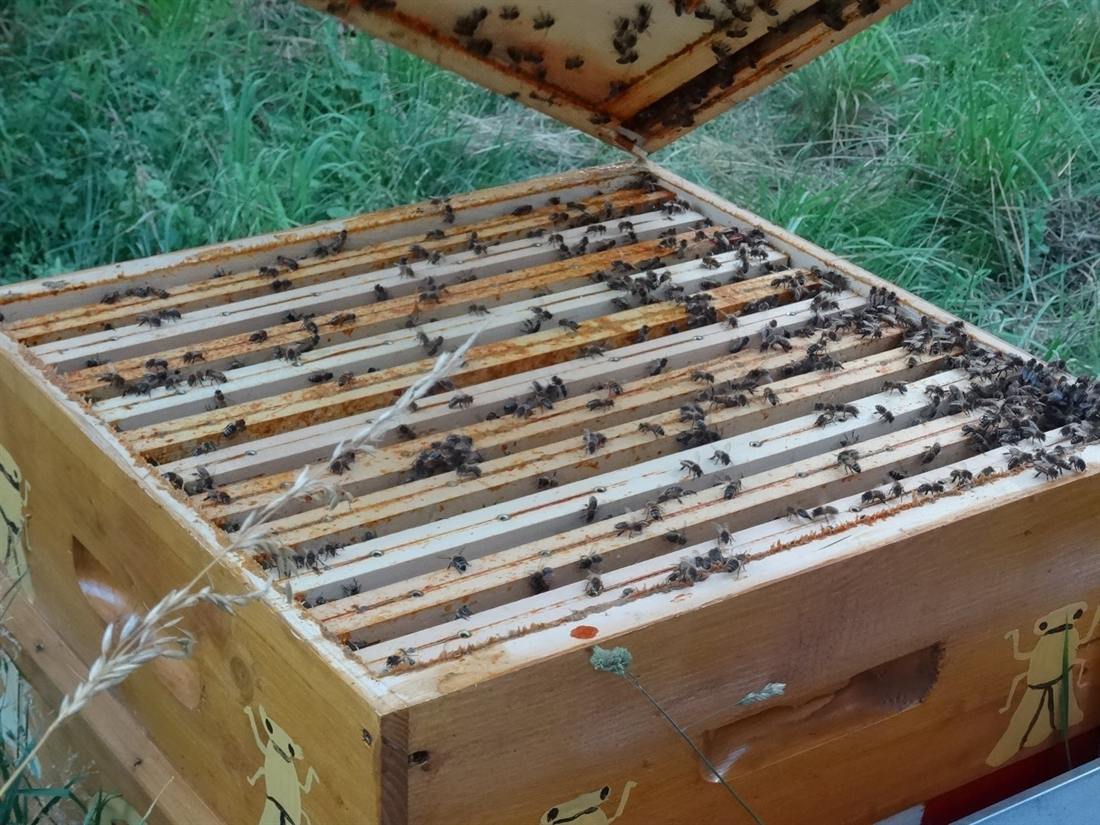
There are ten colonies on the estate. That is a small apiary by any commercial measure and a well-judged one for what it is asked to do: pollinate a conservation orchard of twenty-six fruit species, produce honey for direct sale, and act as the most sensitive instrument the farm owns for the health of the land around it.
« Alitur liquantibus ceris, quas in substantiam pretiosae huius lampadis apis mater eduxit. »
Exsultet, the Easter proclamation
It is fed by the melting wax, which the mother bee brought forth for the substance of this precious lamp.
The apiary
Ten production colonies, declared to the French apiary register. They are not uniform, and that is deliberate.
Seven colonies are headed by queens of local Occitan origin — bees whose ancestors have been selected, informally and by survival, against this exact climate. Three are headed by queens brought from Austria, of Carniolan descent: a line known for explosive spring build-up, economical winter consumption and gentleness on the comb.
Running two lines side by side in one apiary is useful beyond the honey. It means every observation the farm makes — about build-up, about overwintering, about response to a dry August — comes with a built-in comparison. Colonies of different backgrounds in the same forage and the same weather is the closest a ten-hive apiary gets to a controlled experiment.
What is in the jar
Honey from this estate tastes of the estate, and the estate changes month by month. Spring honey carries the orchard — twenty-six fruit species flowering at once inside a sheltered enclosure, which is an unusually concentrated nectar flow. Midsummer brings lime and the aromatic beds. Then, in the hardest weeks of the year, comes buckwheat: dark, malty, almost savoury, and the reason August is not a famine here.
The colonies stand on ground where no synthetic pesticide, herbicide or fungicide is applied to any crop. The honey is sold as honey from the estate, under the rules that govern beekeeping rather than those that govern the farm's plant certificate.

What the bees have to eat
An apiary is only as good as its forage calendar, and the diversity of this farm shows up most clearly here. The gaps — the weeks when nothing is in flower and a colony eats its reserves — are what break a small apiary, and the cropping plan closes most of them almost by accident.
| Period | In flower on the estate |
|---|---|
| February – March | Almond, the earliest of the orchard species; willow and hedgerow |
| April – May | The orchard in full flower: apple, pear, cherry, plum, peach, quince, medlar. Acacia. Rape and hedgerow beyond the estate |
| June | Lime; the first of the aromatic plants; flowering margins and permanent grassland |
| July – August | Sunflower and buckwheat — the two crops that cover the hardest gap in the year; lavender, monarda, savory, mint |
| September – October | Late aromatics, ivy, strawberry tree |
Buckwheat is worth singling out. It flowers in high summer, when the landscape around is cut, harvested and dry, and it is grown here for agronomic reasons entirely of its own. The colonies benefit from a decision that was made about weed control.
What kills colonies
Beekeeping in south-western France is not what it was twenty years ago. The farm is candid about the pressures, because the reason it is interested in colony monitoring is that it has felt them.
Asian hornet (Vespa velutina)
Established across the South-West. Hornets hover in front of the hive entrance and take foragers on the wing. The damage is not only the bees killed: a colony under sustained pressure stops flying, stops collecting, and goes into winter light. Autumn is the critical period, and it coincides exactly with the saffron harvest, when attention is elsewhere.
Varroa
The parasitic mite is present in every apiary in Europe. It feeds on developing brood and transmits viruses; left alone it will destroy a colony within a season or two. Managing it without routine synthetic treatment means knowing the infestation level, which means counting — and counting means opening hives.
Drought and heat
A dry summer does not only stop the nectar. It shortens the flowering of everything, forces the colony to spend foragers on water collection, and can turn a productive August into a net loss. Drought years are increasingly the norm here.
Loss of floral resources
The surrounding landscape has fewer flowering weeks than it once did. A colony can starve in a green countryside. This is the pressure the farm can do most about, and the reason the hedges, the margins and the long-flowering crops are maintained.
Disease and extreme weather
Brood diseases, a failing or lost queen, an unnoticed swarm, a hailstorm that flattens the forage in twenty minutes. Most are survivable if they are caught early, and not if they are not.
How the colonies are managed
The apiary is run on the same principles as the rest of the farm: natural products and herbal preparations rather than routine chemical intervention, and observation rather than the calendar. That choice has a direct consequence.
A system that does not treat preventively must detect early. A beekeeper who treats every colony on a fixed schedule does not need to know which ones are in trouble. A beekeeper who does not has to know, and has to know soon enough to act. Detection is the whole burden of the method.
At present that detection is done by opening the hive, and the opening itself costs something: every inspection chills the brood, breaks the propolis seal, costs the colony a day's work and risks the queen. The beekeeper is forced to choose between knowing and not disturbing.
Monitoring, and why the farm is interested in it
Continuous sensing offers a way out of that trade-off. Temperature, humidity and acoustic signals from inside a hive carry a great deal of information: brood-rearing is visible in the temperature trace, queenlessness and swarming preparation have acoustic signatures, and a colony going into decline usually shows it in the data before it shows it to the eye at the entrance.
If that works, the beekeeper opens the hives that need opening and leaves the others alone. Inspections fall, disturbance falls, and interventions happen earlier. If it does not work — if the alerts are noise, or the indicators do not transfer between colonies of different genetic backgrounds — that is worth knowing too, and this apiary is an unusually good place to find out, precisely because it runs two distinct lines side by side.
Digital hive monitoring is one of the farm's active research themes, and the apiary is offered to partners as a test site for it.

The apiary is declared to the French national register of apiaries, as required. Colony numbers vary through the season with swarming, losses and division; ten is the number of production colonies maintained.
A ten-hive apiary with two genetic lines
Small, fully documented, under real organic-farm management, and beside a twenty-six-species orchard: a realistic environment for testing pollinator technology.