
The farm kitchen
The workshop, in the undercroft of building C
An autoclave, a gas kettle, a steam oven, a fruit dryer and two cold rooms, under eighteenth-century brick vaults.
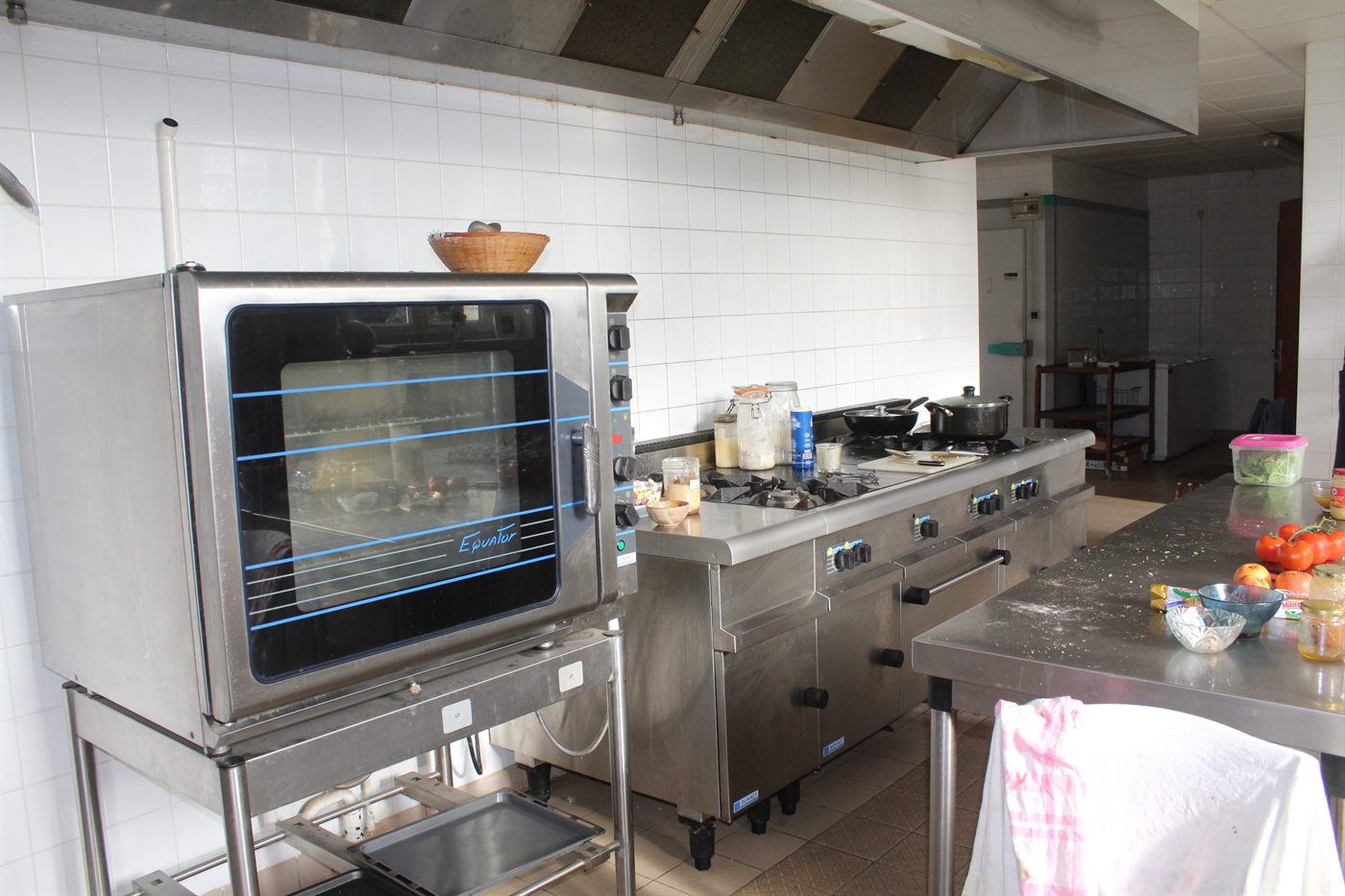
A pêche sanguine holds for two days. A Reinette Choureau bruises easily. Courgettes arrive all at once and last a fortnight. What justifies growing old varieties also requires somewhere to cook them. That place is sixty-five square metres: three-metre vaults, a door onto the cloister garden, and a hot line built to food-industry standard.
« Omnia vasa monasterii cunctamque substantiam ac si altaris vasa sacrata conspiciat. »
Rule of Saint Benedict, chapter 31
Let him regard all the vessels of the monastery and all its goods as the sacred vessels of the altar.
Why there is a workshop
A harvest arrives whole within a few weeks and does not wait. Sold fresh, it is sold when everyone else is selling, and what does not go is lost. A workshop does not change the harvest; it changes what can be done with it.
- Selling is separated from picking. A jar keeps for a year. The fruit it was made from was ripe for nine days.
- The seconds find a use. Ripe, marked, oddly shaped, too soft to travel: in the fresh trade a loss, in the workshop a raw material.
- Fragile varieties remain worth growing. Part of the conservation orchard could not otherwise be sold at all.
- The work spreads across the year. Pulp frozen in August becomes February's jam, and winter ceases to be an empty season.
Elsewhere
This is old work in monastic houses, and there is nothing particular to this one in it. The Trappists of Saint Joseph's Abbey in Massachusetts have been making preserves since 1954; Westmalle sells cheese and jam alongside its beer; Chimay makes four cheeses. A community that lives from its land learns early to keep what it harvests.
Forward flow: the principle the whole plan obeys
French food hygiene rules turn on one idea, the marche en avant: the building must be arranged so that product moves continuously from raw material to finished good, and never doubles back. A dirty crate must not cross a clean one. This is why the plan has two airlocks and three annexes rather than one big room.
- Reception. Crates arrive from orchard, garden and drying room. Weighed, recorded against plot and date, sorted, held cool. Anything below standard is turned away here and not further in.
- Cold preparation. Washing, sorting, grading, stoning, peeling, trimming. The wettest and dirtiest step, kept in its own annexe with a pass-through refrigerated cabinet feeding the hot line so nobody carries a crate back through.
- Transformation. Pressing, pulping, milling, mixing. Here a crate of fruit becomes a batch and acquires the number that will follow it to the label.
- Cooking and heat treatment. Gas kettle, steam oven, autoclave. The critical control point: time and core temperature recorded for every batch.
- Filling and closing. Filled hot, capped, inverted or retorted according to the product.
- Cooling, labelling, storage. Ambient store by batch; cold room and freezers for what must stay cold.
- Wash-down. Utensil sink, dishwasher, cleaning station — on the return circuit, never crossing the forward one.
The equipment, and what each piece is for
| Equipment | What it does |
|---|---|
| Autoclave | Pressure sterilisation above 100 °C, required for low-acid vegetables and prepared dishes in a sealed jar. |
| Autoclave steriliser | Second vessel: a sterilisation cycle runs two hours, and the rest of the line cannot wait. |
| Positive cold room, fully fitted | Holds incoming fruit that arrives faster than it can be worked, until there is time to take it up. |
| Ventilation and induction set: hoods, recessed lights, two extraction hatches, four make-up air inlets, extract and supply units | A kitchen boiling fruit produces much steam. Badly extracted, it condenses on the ceiling and falls back into the pans. |
| Arcos fruit and vegetable dryer | Dried apple, pear, fig, tomato. It removes water instead of adding sugar: another way of keeping fruit. |
| Dishwasher with backed table, sink and spray | Wash-down capacity sized for the line: below that, production stops in mid-afternoon. |
| Electric convection-steam oven | Roasting, drying, controlled steam: the intermediate tool between the kettle and the dryer. |
| Gas kettle | Jam, compote, sauce, purée, fruit paste. Large jacketed volume, fast response. It is the appliance most often in use. |
| Three refrigerated cabinets, one pass-through | The pass-through links cold preparation to the hot line through the wall, which avoids any doubling back. |
| Six stainless steel tables | Work surface. In September, working space is what is shortest. |
| Four-burner range on stand | Small batches and trials: a recipe is tested before a hundred jars are made of it. |
| Ice churn | Sorbets from the varieties that take other treatments badly. |
| Two freezers | Pulp frozen in August gives February's jam, and spreads the work across the year. |
| Two stainless sinks with sliding drainer | One for produce, one for utensils, with no possible confusion. |
| Grease separator | Protects the micro-treatment plant downstream. |
| Linear Fermostock shelving, stainless hand-wash basin | Stock rotation by batch; hand washing at the workstation itself. |

The craft: what actually makes food keep
Preserving is not one technique but four, and which one applies is decided by the chemistry of what is in the pan. This is the part that equipment lists never explain.
Acidity, and why fruit is easy and vegetables are not
The dividing line in all preserving runs at about pH 4.6. Above it, in low-acid foods — beans, most vegetables, prepared dishes — Clostridium botulinum can survive boiling water and grow without air inside a sealed jar. Below it, it cannot.
Fruit sits comfortably below that line, which is why jams, compotes and juices can be safely pasteurised at or near 100 °C. Vegetables and cooked dishes sit above it, and the only correct answer is pressure sterilisation above 100 °C. That single fact is why there is an autoclave at all, and why the room is planned around it.
Sugar, water and why jam does not spoil
Sugar in a jam is not mainly a flavouring. It lowers water activity — the water actually available to microorganisms — and at a high enough concentration nothing can grow, which is why an old-fashioned jam survives an unheated cupboard. It also interacts with pectin and acid to set the gel, which is why reducing the sugar in a traditional recipe changes the texture as well as the keeping.
Old varieties complicate this productively: their acidity and natural pectin vary far more than commercial fruit, so the recipe is adjusted to the batch rather than the batch to the recipe.
Heat, and the point of the core temperature
What makes a product safe is not the temperature of the water bath but the temperature reached at the coldest point inside the jar, held for long enough. A large jar of thick purée takes far longer to arrive there than a small jar of thin juice. Every batch is recorded for time and core temperature, and those records are the difference between a food business and a kitchen.
Drying, the other route
Instead of adding sugar or applying pressure, take the water out. Dried apple rings, pear, fig and tomato keep on water activity alone, weigh a tenth of what they did, need no cold chain, and taste of concentrated fruit rather than of syrup. The same physics governs the herb drying room at the other end of the estate, with a far tighter tolerance.
Freezing as a scheduling tool
The least glamorous and most useful. Pulp, purée and whole fruit go into the freezers at the moment of ripeness and come out when there is time to cook them. Without it, a diversified orchard delivers its entire year's work into a three-week window, in which everything ripens at once.
What comes out of it
The recipes are the abbey's own. The range follows the orchard and the garden, which means it changes with the season and occasionally with the weather.
From the orchard
- Juices, pressed single-variety where a variety deserves it
- Jams and preserves
- Compotes and purées
- Fruit pastes and fruit confectionery
- Dried apple, pear, fig
- Sorbets
From the garden and the plants
- Sauces, passata, vegetable purées
- Bottled vegetables and prepared dishes
- Dried tomato
- Dried herbs and infusion blends
- Dried edible flowers
- Saffron, in stigmas


Everything is currently sold at the farm, to people who come for it. That is a choice rather than a limitation: these are small quantities, from varieties that exist in very few places, and the shortest possible chain is also the one that explains them best.
The building
Building C runs along the cloister garden, and its lower floor was designed — in the eighteenth century, for a community that fed itself — as a service range: kitchen, refectory, stores, with a covered gallery outside and a sunken area to the south for light and air. The project restores that use with modern requirements laid over it.
| Room | Area | Use |
|---|---|---|
| Kitchen | 65 m² | The workshop proper: cooking, filling, the whole hot line |
| Kitchen annexes (three) | 8 / 9 / 5 m² | Cold preparation, dry stores, technical duct |
| Airlocks (two) | 11 / 10 m² | Separation of clean and dirty circuits; waste handled without crossing the kitchen |
| Stores | 15 m² | Ambient storage: jars, lids, labels, finished stock by batch |
| Sanitary and changing | 6 / 7 m² | Out of the production flow, as the rules require |
| Refectory | 66 m² | Adjoining; tastings, visits, training |
| Office | 35 m² | Batch sheets, traceability, the sanitary control plan |
What has to be built into an old building
An agrifood workshop inside an eighteenth-century monastic range is mostly a plumbing and surfaces problem. The works specification is specific about it.
- Tiling and wall and floor coverings — surfaces that can be washed down
- Three annexes, an airlock and a technical duct for compliant waste handling
- Masonry restoration, scaffolding, materials
- Floor built to standard, laid to falls, with floor gullies
- Plasterboard and suspended ceiling
- Fire-rated joinery
- Electrical installation: distribution board, 220 V and 380 V outlets
- Plumbing
- Finishes and food-grade paint
- Changing rooms and sanitary facilities
- Cladding and wall upgrades
- Gas distribution
- Waste-water collection, connected to the micro-treatment plant
Two items on that list matter more than they sound. Floors laid to falls with gullies, because a workshop is washed down and the water has to leave by itself, fast, without pooling and without letting anything crawl back up the drain. And three-phase 380 V, because an autoclave and a steam oven are not domestic appliances.
The waste water goes to a 45-person-equivalent micro-treatment plant with a screen and a grease separator. A kitchen that boils fruit all September puts sugar and organic load into its drains; on an estate with its own spring and wells, where that load ends up is not an afterthought.
Rules, records and the sanitary control plan
An on-farm workshop in France operates under one of three statuses, depending on who it sells to: direct sale to the final consumer, a formal exemption from approval covering limited sales through intermediaries, or full sanitary approval for unrestricted wholesale. Since January 2024 these controls sit with the Ministry of Agriculture.
All three, without exception, require a plan de maîtrise sanitaire — the documented control plan — and the person running the workshop must be trained in good hygiene practice and HACCP. In practice that means:
- A written hazard analysis, with the critical control points identified and the limits set for each
- Batch sheets: what went in, from which plot, on what date, and what came out
- Time and core-temperature records for every heat treatment
- A cleaning and disinfection plan — what, with which product, how often, by whom, and how it is verified
- Retained samples held to the durability date
- Labelling that carries ingredients, allergens, net quantity, durability date and lot identification
- Traceability in both directions: from a jar back to a tree, and from a tree forward to every jar
The paperwork is not overhead. It is the same record-keeping that makes the farm usable as a research site, and it is why a batch can be traced back to a single row of the orchard.
The workshop is being taken through organic certification for its processing scope, alongside the farm's existing certificate for the crops themselves.
Nothing leaves as waste
Every step of preparation makes something that is not the product: skins, stones, pulp, stalks, trimmings, spent herb material. The question is whether that leaves as a disposal cost or stays as an input.
- Short loops first. Second-grade fruit becomes compote before anyone considers anything cleverer. Trimmings from one product are the raw material of another.
- Back to the ground. Composted residue returns organic matter to soil that wants it, closing the loop inside the estate.
- Extraction, where the chemistry justifies it. Skins and pressing residues carry real concentrations of polyphenols with value in food, nutraceutical and cosmetic applications. Recovering them is genuine process engineering, and it is one of the farm's research themes.
The scale of the opportunity
Europe grows around twenty-seven million tonnes of grapes, roughly three-quarters of it for wine, and about a fifth of the grape material comes out again as pomace. Published extraction work recovers between 13% and 22% of dry mass as polyphenol-rich extract using water-and-ethanol systems. The raw material is abundant, regional, and largely disposed of at low value — which is exactly the profile of a problem worth working on.
Post-harvest losses in fresh fruit and vegetables across Europe run at fifteen to thirty per cent, and the most perishable products are the worst hit. A kitchen is the first answer to that. Natural approaches to extending shelf life — which the farm also works on — are the second.
The same kitchen cooks for the guest house upstairs: twelve rooms in this building, fifteen people, one group at a time. A group eating in the refectory is thirty metres from the hot line and two hundred from the garden the vegetables came out of.
A real post-harvest setting
Diversified organic produce, genuine handling constraints, a documented kitchen and an operator who will tell you when your method failed.