
Activities
The market garden
Twenty vegetables named on the organic certificate, grown inside the old monastic enclosure.
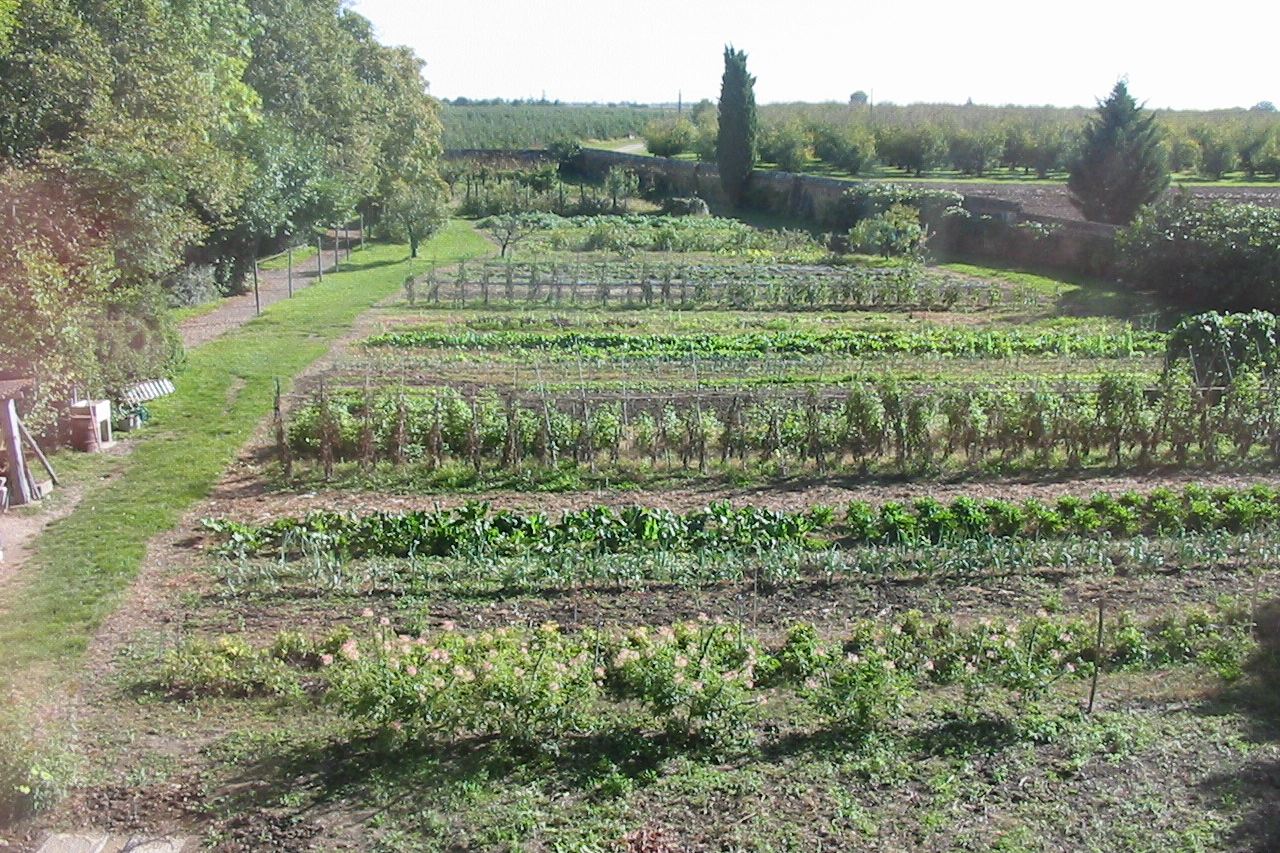
The organic certificate carries two separate lines for this activity. One reads diversified market gardening as a production system; the other names the vegetables individually, twenty of them. That distinction matters. It is the difference between a farm that grows a crop and a farm that runs a garden — a rotation of many species in the same ground, where the succession is the method.
The twenty vegetables on the certificate
These are the names as ECOCERT recorded them, grouped by how they are actually managed here.
Fruiting vegetables
- Tomato
- Aubergine
- Sweet pepper
- Chilli pepper
- Cucumber
- Gherkin
The summer block. All are planted out after the last frost risk, and all compete for the same protected, warm, well-drained ground — which is what makes the rotation tight.
Squashes
- Potimarron
- Pumpkin
- Squash
- Courgette
Squashes earn their place twice over: they crop heavily, they store for months without refrigeration, and their canopy smothers weeds on ground that would otherwise need repeated mechanical work.
Roots and tubers
- Potato
- Carrot
- Celery
Leaves and stems
- Chard
- Salad leaves
- Leek
- Cabbage
The winter half of the garden. Leeks and cabbages hold in the ground and are cut as needed, which spreads the work and the sales across months when nothing else is ready.
Legumes
- Bean
- Broad bean
- Pea
These are the hinge of the rotation: they fix their own nitrogen and leave the ground better than they found it, which is why the field rotation uses the same principle at a larger scale.
The certificate also records a separate pulse line, legume mixture, grown in the fields rather than the garden. See cereals and field crops.

Why the enclosure matters
The garden sits inside the walled enclosure of the abbey. Monastic kitchen gardens were put inside walls for reasons that have not changed: a wall stops wind, and wind is what dries a seedbed, tears a courgette leaf and knocks a staked tomato over. It also absorbs heat through the day and releases it at night, which is why the south-facing side is the last part of the garden to take a frost.
The practical effect is a longer season at both ends and a measurably calmer microclimate than the open fields two hundred metres away. It is the single most valuable piece of inherited infrastructure on the farm, and it was built in the eighteenth century.
The enclosure also concentrates the work. Beds, water, tools and the processing workshop are within a few minutes of each other, which on a small holding decides whether a crop gets picked at the right moment.
How they are grown
Organic market gardening has no single technique that replaces chemistry. It has a set of habits that, taken together, make chemistry unnecessary.
- Rotation before anything else. No family returns to the same ground for several seasons. It is the least costly way of limiting disease, and one of the few that acts on soil-borne pathogens.
- Legumes in sequence. Beans and peas feed the nitrogen that the brassicas and the leaf crops take out, so fertility is built inside the rotation rather than bought.
- Mechanical and manual weeding. Timed early, when weeds are at the white-thread stage and a single pass does what three later passes cannot.
- Ground kept covered. Bare soil in a Tarn-et-Garonne summer loses water and structure fast. Mulch, green manure or a squash canopy keeps it shaded.
- Varietal choice over intervention. Where a variety is known to resist a local disease, it is preferred to a more productive one that will need managing.
- Observation. On twenty crops in one enclosure, walking the beds is a diagnostic instrument. Most decisions here are made on what is seen rather than on a calendar.
Through the season
| Period | In the ground | Being picked |
|---|---|---|
| February – April | Sowing under cover; potatoes, broad beans, peas and early carrots go out | Leeks, cabbage, chard held from winter |
| May – June | Tomatoes, peppers, aubergines, cucumbers and squashes planted out after the frost risk | Salad leaves, broad beans, peas, early carrots |
| July – September | Irrigation becomes the whole job; late sowings for winter | The summer block: tomatoes, courgettes, aubergines, peppers, beans, cucumbers |
| October – December | Squashes lifted and cured for storage; ground covered | Squashes, leeks, cabbage, chard, celery, the last roots |
Water is the constraint that governs this calendar. July and August decide the year, and they are getting harder: the water and irrigation page sets out what the farm does about it.
After the harvest
A diversified garden produces gluts by design. Twenty crops cannot all be sold fresh at the moment they are ready, and on a small holding the difference between a good year and a bad one is usually what happens to the surplus rather than what happens to the crop.
Tomatoes arrive in a wall in August. Courgettes have to be picked every other day or they become marrows. Squashes, by contrast, are patient: cured properly they sit in a cool store until February and ask nothing of anyone. Reading those temperaments correctly is most of the skill.
What travels and keeps is sold fresh at the farm. What does not goes fifty metres to the kitchen and comes out as passata, sauce, puree, dried tomato or a bottled dish — which is how a fortnight of courgettes becomes something you can eat in March. What is genuinely past it returns to the ground as organic matter.
Post-harvest loss in fresh fruit and vegetables runs at fifteen to thirty per cent across Europe, and leaves and soft fruit are the worst affected. That figure is why the farm works on natural post-harvest preservation as a research subject rather than an abstraction: it is losing that produce itself, and it would rather not.
Twenty crops in one enclosure
Diversity on this scale is unusual, and it is exactly what makes the garden useful for trials in crop monitoring, disease detection, irrigation scheduling and post-harvest handling.