
Activities
The orchard, planted as a scallop shell
A conservation orchard of old South-West varieties, laid out to be read from the sky.
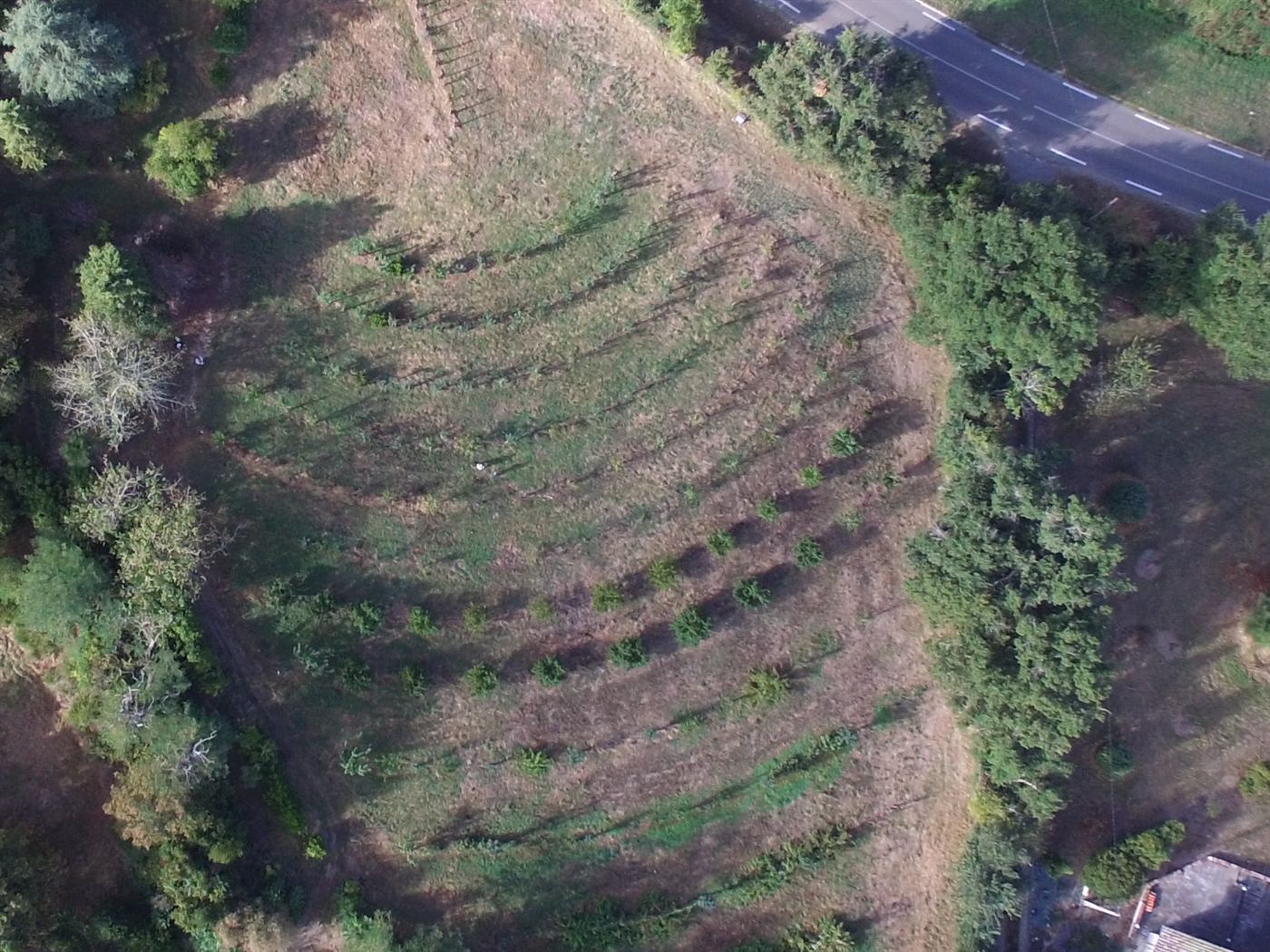
The rows of this orchard curve in concentric arcs that fan out from a single point, forming a scallop shell surmounted by a cross: the emblem of Saint James, set in the ground of a Benedictine estate. Straight lines would have been easier to work. The orchard is nonetheless a working conservation orchard, holding more than a hundred old fruit varieties of south-western France.
Five of them, to begin with.
- Noire d'ItxassouGeresi BelxaThe Basque black cherry, under its own name.
- Cuisse MadameÉpargneA July pear. It will not keep eight days, which is its whole commercial history.
- CatillacA cooking pear that keeps until spring. The exact opposite of the one above.
- Anis basque précoceAnixaAn apple that tastes of aniseed. Its name says it comes early.
- Griotte de MoissacFrom twenty kilometres downstream, on the Tarn.
The full list runs to more than a hundred, across twenty-six species.
The design, and what it costs
The shell is not a motif painted onto a conventional plot. The planting positions were set out along the arcs, which means no two rows are the same length, the spacing opens as the rows move away from the hinge, and machinery has to follow curves. That is a real operational cost, accepted for two reasons.
The first is that the scallop is the sign of Saint James, and a farm that works monastic land can afford one gesture that says so. The second is agronomic: a fan of curved rows on this ground follows the contour better than a grid would, which matters on a slope that has to hold its water. The design and the drainage happen to agree.
Read from above
The orchard was laid out knowing it would one day be photographed from the air, and it is only from there that the figure resolves. On the ground you see an orchard with unusually generous headlands; from a hundred metres up you see the shell, the ribs, and the cross above it.
Inside the enclosure
The plot sits immediately east of the abbey ranges, sheltered by mature trees on two sides. That shelter is worth several degrees on a spring frost night, which for apricot and almond — the two earliest species here — is the difference between a crop and no crop.

A host site for the Conservatoire Végétal Régional d'Aquitaine
Since 7 May 2015 the farm has been a site d'accueil des collections of the Conservatoire Végétal Régional d'Aquitaine. The problem of a living collection is simple: a variety that exists in one place only is a variety one storm away from extinction. Host sites are the answer. There are thirty-five of them across seven departments; this orchard is one.
The practical consequence is that the trees were not chosen from a catalogue of what sells, but from what this region used to grow.
What the agreement provides, on both sides
The Conservatoire supplies the trees from its own nursery, agrees the design of the orchard and the choice of species and varieties, plants, trains the site's staff, prunes, and makes technical visits.
In return the site keeps the collection alive, may not propagate or distribute the material without written authorisation, and gives the Conservatoire access to take samples and one to five kilos of fruit per variety for assessment and display. The agreement was signed at its intermediate level.
The Conservatoire, and how the world keeps its fruit
The Conservatoire has spent four decades collecting the fruit of the South-West. On its estate at Montesquieu in Lot-et-Garonne it holds around two thousand accessions of sixteen fruit species — some seven and a half thousand espaliered trees on seventeen hectares of high-density conservation orchard.
Every serious fruit-growing country runs a collection like this. Britain's National Fruit Collection at Brogdale in Kent has held the national reference since 1952: nearly 3,500 varieties over 150 acres, with two trees of each so that losing one is not losing the variety.
The French model differs in one respect that matters here. Rather than concentrate everything on one site, the Conservatoire duplicates its collections outward onto working farms. The risk is spread, the varieties are grown by people who sell the fruit, and the region gets its own heritage back in a form it can eat.

The varieties
The names are worth reading slowly. They are a map of the South-West: Basque, Gascon, Béarnais, Quercy and Tarn, alongside the classic French pears of the nineteenth century.
Cherries
- Noire d'Itxassou — Geresi Belxa
- Abouriou
- Bigarreau de Mai
- Bigarreau Marbré
- Cœur de Pigeon blanc
- Griotte de Moissac
- Guindouhl du Tarn
- Mourette — Amourette
- Noire tardive à longue queue
- Tonkinoise
- Xapata
The Itxassou black cherry and the Xapata are Basque; the Griotte de Moissac comes from twenty kilometres down the Tarn; the Guindouhl is of the Tarn itself.
Pears
- Poire Citron
- Poire d'Anis
- Poire Orange
- Poire Saint Jean
- Beurré Clairgeau
- Beurré Giffard
- Beurré Superfin
- Blanquette
- Boutoc — Poire d'Ange
- Caillaou Rosat
- Catillac
- Duchesse d'Angoulême
- Épargne — Cuisse Madame
- Marguerite Marillat
- Pérou d'argent
- Tarquin des Pyrénées
- Virgouleuse
Catillac is a stewing pear that keeps until spring; Cuisse Madame ripens in July and will not keep a week. Between them they cover nine months of the year.
Apples
- Anis basque précoce — Anixa
- Api Double Rose
- Belle Fleur Jaune
- Belle Louronnaise
- Choureau — Reinette Choureau
- Pomme d'anis tardive
- Pomme Glace
- Golden × Cassou n°167
- Jincoa Sagarra
- Museau de lièvre rouge du Béarn
- Perasse de Gan — Peaxa
Several are cider and sagarra apples from the Basque country and the Béarn. Golden × Cassou is a Conservatoire cross, made to put scab resistance from a local apple into a commercial one.
Peaches and nectarines
- Brugnon rosé de septembre
- Nectarine alberge
- Nectarine blanche
- Pêche sanguine précoce
- Roussane de Juillet
- Roussane Royale
The roussanes and the blood peaches are the old peaches of the South-West: small, intensely flavoured, and impossible to transport — which is why they disappeared from the trade.
Nuts and small fruit
- Hazel Enis
- Hazel Fertile de Coutard
- Blackcurrant Andega
- Jostaberry
- Redcurrant Jonkheer van Tets
- Gooseberry Captivator
- White currant Versaillaise blanche
The small fruit go in as blocks of ten bushes each — enough for a real picking, not a sample.
The wider species range
Beyond the four main species the orchard carries apricot, almond, chestnut, quince, fig, pomegranate, fruiting mulberry, medlar, walnut, persimmon, strawberry tree and olive, together with strawberries and raspberries. The citrus — lemon, orange, mandarin, kumquat and grapefruit — are recorded on the organic certificate as scattered trees: individual specimens in sheltered positions, not a plantation.
All of these species appear by name on the farm's organic certificate. See the full product directory.
Rootstocks, and why they are listed
A fruit variety is only half of a tree. The rootstock decides its vigour, its tolerance of the soil, and how long it takes to come into bearing — and in a conservation orchard it is part of the record. The plantings here use:
| Species | Rootstock | Effect |
|---|---|---|
| Apple | MM 106, and seedling | MM 106 gives a semi-vigorous tree that bears early; seedling gives a full standard that will outlive the people who planted it. |
| Pear | Quince BA 29, and seedling | BA 29 for earlier bearing and a manageable tree; seedling where the variety is incompatible with quince or where longevity matters more. |
| Cherry | Colt | Moderates the natural vigour of cherry, which on its own roots makes a tree nobody can pick. |
| Peach | Seedling | The traditional choice on these soils; peach on its own kind tolerates the ground here better than dwarfing alternatives. |
Trees arrive either as maiden whips or as two-year grafted plants, and both forms are used deliberately: whips are cheaper and shape better, two-year trees bear sooner.
Why a small farm plants old varieties
The commercial argument against them is simple and correct: old varieties yield less, ripen unevenly, bruise, and will not keep in a cold store for six months. They were bred for a world of local markets, not for a distribution network.
The arguments for them are less obvious and, on this farm, decisive.
- Local adaptation. A variety selected in the South-West over two centuries has already been tested against this climate's heat, its frosts and its diseases — by two centuries of growers discarding what failed.
- Spread of risk. More than a hundred varieties with different flowering dates means a late frost cannot take the whole crop. In a region where April frost is now the main orchard hazard, that is not sentiment but insurance.
- Genetic resource. Scab resistance, drought tolerance and flowering behaviour are traits breeders need. They survive only in living collections.
- Flavour, and what is done with it. A blood peach cannot be shipped, but it can be sold at the gate, made into a puree, or dried. The whole processing question follows from this.
- A long flowering season. Twenty-six fruit species flowering from February almond to autumn strawberry tree keeps the bee colonies fed across the year.
What the orchard produces, and what becomes of it
The orchard is young: the main plantings date from 2015 and were extended in February 2025, so much of it is still coming into bearing. As it does, the fruit follows three routes.
- Fresh, at the farm. What travels: apples, pears, quinces, nuts — sold at the gate to people who came for them.
- Into the kitchen. Juices, purees, compotes, pastes and sorbets from what does not travel: the blood peaches, the soft old apples, the gluts. This is what the workshop is for, and half the orchard depends on it.
- Back to the collection. Fruit sampled by the Conservatoire Végétal for identification and display, and graftwood taken for propagation under its control.


An orchard is also a research site
Twenty-six species and more than a hundred varieties on one plot, with full plot records, is an unusual test bed for flowering models, frost risk, disease observation and pollination studies.